
Woodstock Directory Collections to Check
No authoritative catalog page lists a continuous, standalone Woodstock city directory run. That gap is important. A sound search starts with the collections that are confirmed, while asking local staff to identify any county, metro, telephone, or reverse volumes that contain Woodstock. The table distinguishes a known date range from a shelf question that remains open.
| Collection | Known years | Where held | How to use it |
|---|---|---|---|
| Woodstock or Cherokee directories | Exact run not published | Sequoyah Regional Library and History Cherokee | Catalog and staff shelf search |
| Federal population census | Released through 1950 | NARA, FamilySearch, library databases | Household and later address evidence |
| Cherokee county-record microfilm | Principally pre-1900 | Georgia Archives and FamilySearch | Tax, deed, court, and probate books |
| Cherokee survey plats | 1832 | Georgia Archives Virtual Vault | Land-lot geography, not occupancy |
| Georgia Sanborn maps | 1884 to 1941 statewide | Digital Library of Georgia | Building context where a place has a sheet |
| Newspapers, obituaries, annuals | Title-specific runs unverified | Library, DLG, History Cherokee | Kin, school, residence, and date clues |
A year should be called unavailable only after staff check the catalog and local-history inventory. “Not listed online” does not mean that no book exists. It means the public shelf record is incomplete.
Woodstock City Directory Shelf Gap
The most candid answer about printed city directories is also the most useful: no official source reviewed names the publisher, first year, last year, or reverse-section dates for a Woodstock series. Woodstock was long smaller than Atlanta and Canton. Its residents may have been grouped into Cherokee County telephone books, rural-route lists, suburban Atlanta editions, or a publisher title that never put Woodstock on the cover.
Ask the Sequoyah Regional Library System to search “Woodstock (Ga.) directories,” “Cherokee County directories,” telephone directories, Towne Lake, Canton, and suburban Atlanta. Staff should also check uncataloged vertical files. This city directory search must not fill the shelf gap with made-up publisher years or assumed reverse volumes.
Known gap. Record a publisher and year only from the volume itself, its catalog record, or a librarian’s shelf confirmation.
Ask for Woodstock Reverse Directories
A precise request gives reference staff more routes into the collection. Ask for telephone books as well as city directories. Include Woodstock, Cherokee County, Canton, nearby metro coverage, and the telephone exchange. Then ask whether any volume has a street-order or reverse section. Such a section changes the search from name to address, which is vital when the resident name is unknown.
- Give the address, surname if known, and a narrow year span.
- Ask staff to check the public catalog and local-history shelf inventory.
- Request the title page, publication year, coverage note, abbreviation key, and street-section start.
- Confirm whether scans are allowed and whether fragile books need staff handling.
- Ask if newspaper or directory databases require a card or branch visit.
Telephone books omit people without listed service, but they can cover rural routes and exchange areas missed by a commercial volume. A reverse telephone entry identifies a subscriber at an address. It does not list every member of the household.
Read a Woodstock City Directory Entry
A typical twentieth-century entry may hold more than a name. Read every mark against that volume’s own key because publishers used abbreviations in different ways. No open Woodstock specimen was found, so these are fields to inspect, not claims about a local publisher.
| Printed name | Surname, given name, initials, and spelling as set in type |
|---|---|
| Family notation | Spouse in parentheses or a widow notation when supplied |
| Work line | Occupation, employer, or business affiliation where printed |
| Address line | House number, street, rural route, or rooms notation |
| Other marks | Telephone and owner or householder symbols if that key defines them |
- Criss-cross directory
- A section arranged by street and house number instead of surname.
- Householder index
- A list keyed to the person treated as head or listed subscriber.
- Abbreviation key
- The publisher’s code list, which controls the meaning of short marks in that volume.
Photograph or cite the key with the entry. An “r,” “h,” or “wid” should never be expanded from memory when the book can define it.
History Cherokee Directory Clues
History Cherokee is the county-level stop for items that may not appear in a public catalog. Ask about surname and family files, cemetery surveys, photographs, maps, newspapers, school annuals, and research services. A vertical file can point to an address, business, church, or subdivision even when it is not a formal city directory.
The organization’s page is the source for the image below and the route for a holdings question.

Use any answer as a shelf citation. Capture the collection name, box or file label, date span, and access terms before relying on it.
Woodstock Records Beyond City Directories
When a city directory year is missing, official county books provide a dated substitute. The Georgia Archives Cherokee County catalog cards describe preserved microfilm. Most county microfilm is pre-1900, though a book begun before 1900 may continue later. Deeds name transaction parties, tax digests place taxpayers in a fiscal year, and probate or court volumes can explain a name’s appearance or disappearance.
The catalog card interface shown here helps identify a record group before a visit or image search.
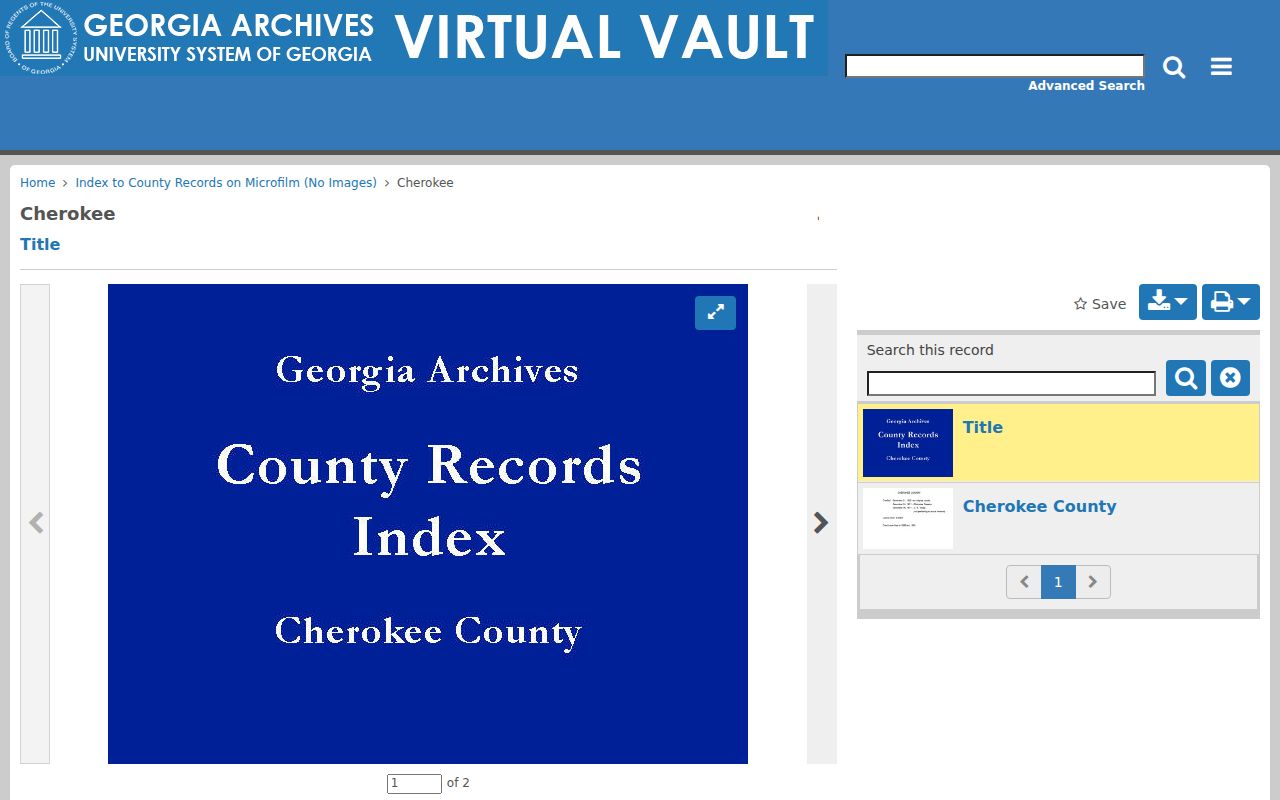
FamilySearch may provide more Cherokee County images after free registration. Cite the book, volume, page, and repository, not just a search result.
The Archives also offers a digitized county-record collection.
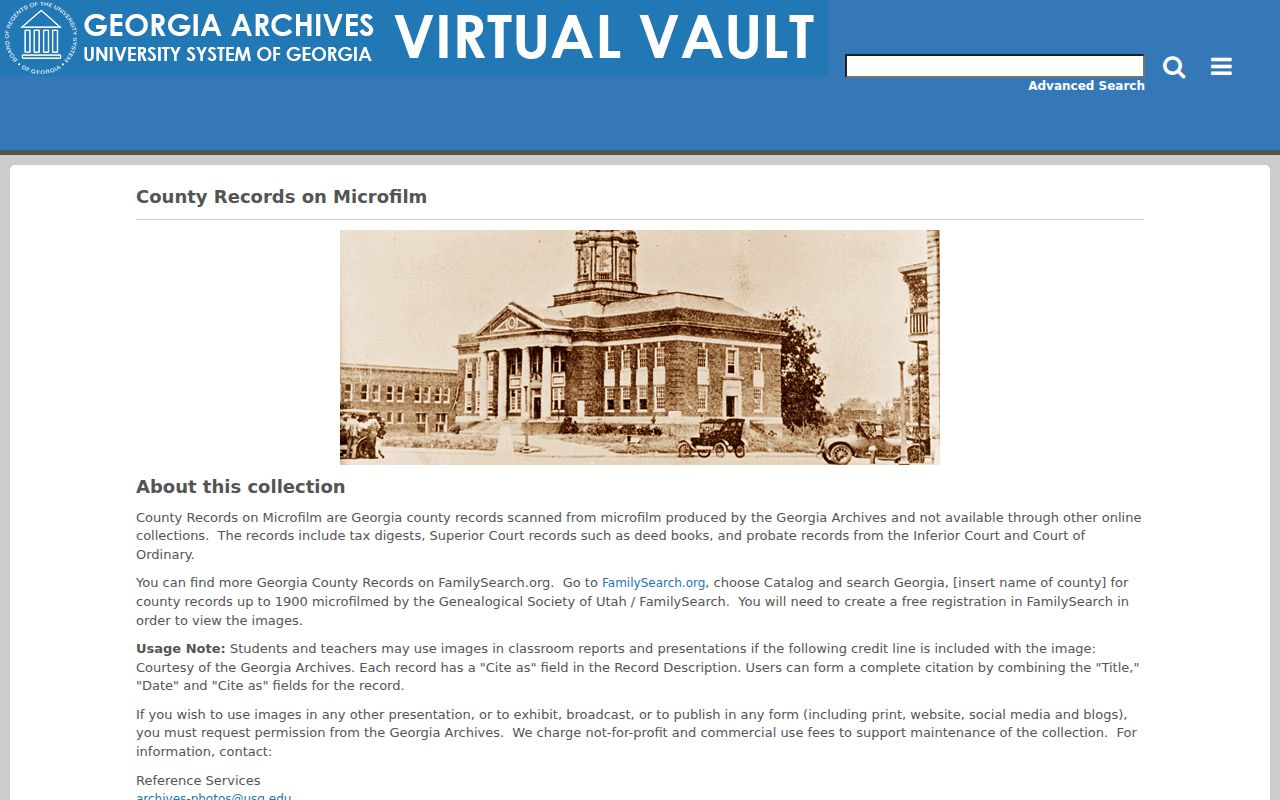
These official records can anchor a person or parcel between the years covered by printed lists.
Woodstock Directory Names Meet 1832 Land
Modern streets sit on an older survey frame. Cherokee County was created in 1831, and the 1832 lottery and survey divided land by district, section, and lot. That legal geography still appears in old deeds and may survive inside a modern parcel description. It can bridge a known Woodstock parcel to county books written long before a street address was stable.
The Georgia Archives district plat is a verified image of that survey system.
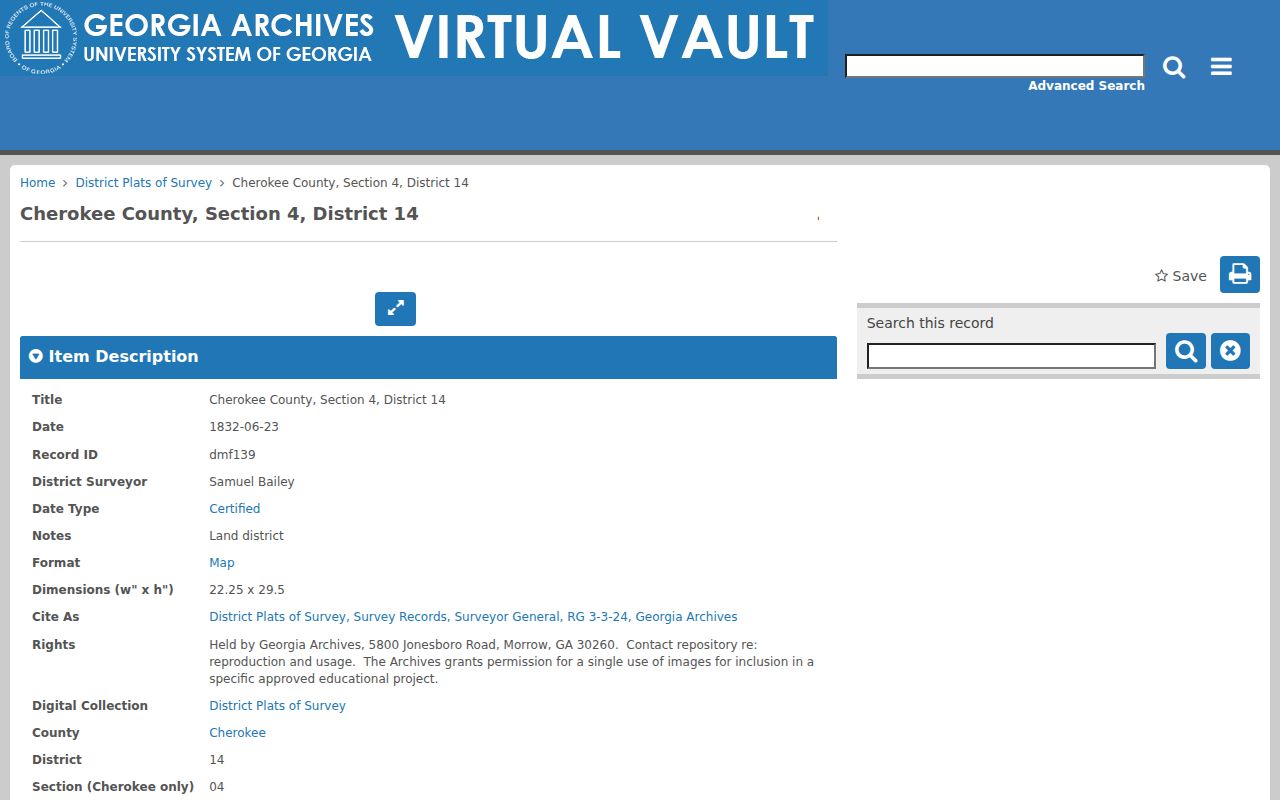
The plat proves geography, not who later owned or occupied the land. Pair its lot reference with deeds and tax digests before attaching a person to it.
Map Context for Woodstock Directories
Sanborn fire-insurance maps can show building outlines, uses, house numbers, and utilities. The statewide Georgia collection spans 1884 through 1941, and Cherokee County is represented. A Canton sheet from 1921 is verified, but no Woodstock-specific sheet was located. It would be wrong to use Canton coverage as though it mapped a Woodstock home.
Search the Digital Library of Georgia Sanborn collection by place and date, then verify the sheet title and coverage before using it. Where Woodstock has no sheet, recorded plats and the parcel’s land-lot description are safer geographic tools.
Note: A map can date a structure or number, but it cannot establish the people who lived inside it.
Trace Families Through Woodstock Directories
Once a volume is confirmed, treat each listing as a dated observation. Copy the entry exactly. Check both alphabetical and street sections, then compare the years on either side. Pair the 1940 and 1950 census households with directory volumes just before and after those census dates. This helps separate an actual move from a late canvass or publication delay.
- Begin with a known surname, address, and target year.
- Record the title, year, page, printed name, spouse mark, work line, and address.
- Search adjacent issues and note each changed field.
- Compare the relevant census, deed, and tax year.
- Use an obituary, cemetery source, or probate file when the trail ends after a death.
The detailed shelf method belongs here; a modern address-keyed search belongs on the Woodstock street directory page. Keep ownership and occupancy as separate findings.
Why Woodstock Directory Names Vanish
An omission is not proof that a person left Woodstock. Rural routes, recent moves, people without listed telephone service, renters, spelling variants, and publication lag all create gaps. OCR adds its own errors by confusing letters, initials, and punctuation. Inspect the page image before making a final citation.
Use a worksheet with one row for each target year. Keep columns for printed name, spouse or widow notation, occupation, address, telephone, title, page, and confidence. Write “not listed,” not “not resident.” Rapid local growth makes this care even more useful: Woodstock rose from 23,896 people in 2010 to an estimated 39,895 in 2025, while its historic printed shelf remains incompletely described online.
The library system’s public entry point is pictured below.

A staff answer can turn the open shelf question into a firm citation without inventing years.